Thursday, 30 November 2023

Ted Hughes and Shakespeare


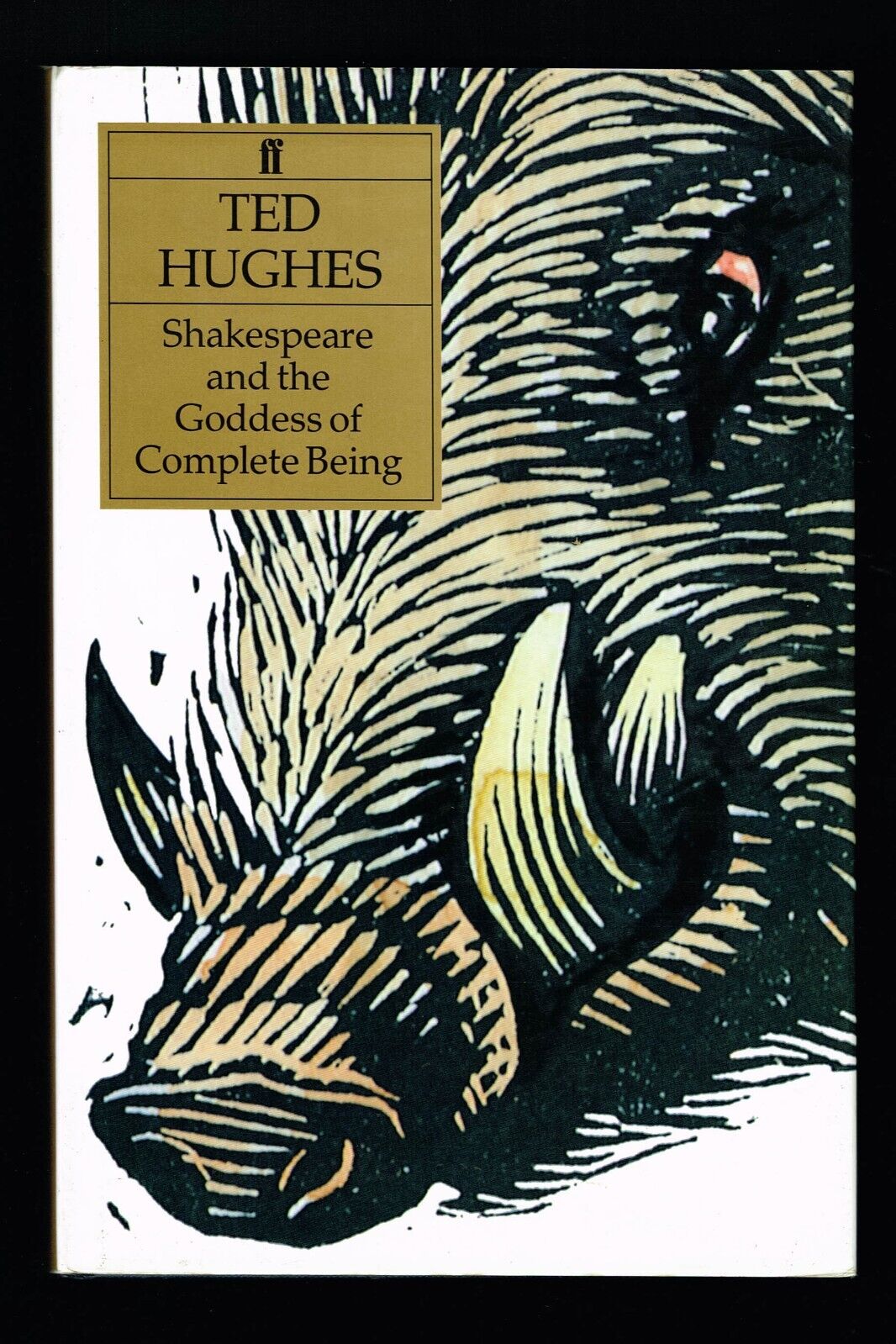
In a little humoresque on Shakespeare in my volume Instead of a Critic, I made passing reference to Ted Hughes’s monumental study Shakespeare and the Goddess of Complete Being. It wasn’t a flattering reference and I omitted to mention that I never made it past the ‘Introduction’. However, when a friendly reader asked me what I thought of the tome, it prompted me to take Hughes’s doorstop of a book off the shelf and look at it again. I still get no further than page 43. But I admire Hughes as a poet, so he must be saying something worth hearing. No?


The book certainly divided opinion when first published in 1992. ‘Exit, pursued by a boar’ was the Observer’s headline above Anthony Burgess’s mystified review. The Independent declared the book to be ‘egregious twaddle’. For John Carey of the Sunday Times it was ‘appalling nonsense… tedious mythical mumbo-jumbo’. But it found supporters – rather fewer of them – in Tom Paulin, Michael Hoffman and Marina Warner.


The idea goes something like this. Shakespeare’s work is bound together as an organic unity by a single mythic-symbolic structure which Hughes calls the ‘Tragic Myth’. Shakespeare’s early poems Venus and Adonis and The Rape of Lucrece embody two great myths of the archaic world, that of the hero who rejects the love of the Goddess and is killed in revenge by a boar; and that of the king, or god, whose crime is rape and whose punishment is banishment. These themes are then followed through in the subsequent plays and in some way correspond to the conflict in Elizabethan society between the Old Religion, Catholicism, and the emergent challenge of Protestantism, especially in its most extreme – and theatre-hostile form – Puritanism. By tapping into the energy of these myths Shakespeare was able to revivify his imagination (and, we might add – though Hughes doesn’t – by uncovering this formula Hughes was able to reconcile himself to the suicides of two women in his life, Sylvia Plath and Assia Wevil.)


At once I see a couple of approaches that on the face of it are contradictory. One is Hughes’s experience of practical theatre work with Peter Brook and Donya Feuer. With Brook he worked as an ‘ideas man’, first at the National Theatre, later at the Centre for Theatre Research in Paris, providing suggestive dramatic situation for the actors to explore. Feuer’s notion, inspired by Hughes, was to shuffle extracts from the plays into what they called a perpetuum mobile performance, one passage merging into another to bring out their commonality: the evolution of one of the Myth’s figures from play to play. 


The other approach, its opposite, is an armchair reading of the Collected Works as plays for the page, not the stage – what the Germans would call ‘Lesedramen’– excerpting them and mingling lyric poems with dramatic speeches. This approach has its origins in Hughes’s Selection of Shakespeare’s Verse, which was first published twenty years earlier.


What unites the approaches is a habit of selective quotation: ripping from context, treating Shakespeare as a ‘single titanic work, like an Indian epic’ (p43). The justification lies in the epigraph from Yeats – ‘the fancy that there is some one myth for every man, which, if we but knew it, would make us understand all he did and thought’. Hughes tell us he’s in search of Shakespeare’s myth, but really he’s in search of his own. Which is acceptable, if he were more honest about it. For those of us who use literature to navigate our lives it’s instructive to watch Hughes, a keen intellect and gifted wordsmith, on the job. Just as a stopped clock will show the right time twice a day, so a totalising vision may occasionally bring particular objects into focus. 


So what is this loose baggy monster? Is it literary criticism? If one penetrates that far, there are probably flashes of insight, discussions of individual passages that might illuminate the text in the way a good literary commentary does. But the wise commentator, his contribution complete, has the good grace to withdraw and leave the reader alone with the text. Hughes cannot do that, because nothing is so specific, so local; everything must be subsumed to his overarching theory of the ‘Tragic Equation’.


If not literary criticism, then what is it? ‘Poetic criticism’? Mythopoeia? The bastard offspring of Robert Graves and C.G. Jung? The response of one creative artist to another? The book is full of fine phrases that might qualify as prose poems: even John Carey, in a scathing review, was taken by a footnote on page 11 about the sow, her ‘elephantine lolling mouth under great ear flaps, like a Breughelesque nightmare vagina, baggy with over-production’. Flicking through later pages, I noticed many a felicitous turn of phrase – the sonnets as ‘the vestibule to the bloody temple of the tragedies’, for example (p64), or Shakespeare’s language as ‘a kind of prodigiously virtuoso pidgin’ (p152). 


Yet I sense dishonesty, subterfuge, the ripple effect of obsession. He deploys the tools of evidence-based scholarship, but craftily.[1] The procedure is to decide what you’re looking for, to ‘look’ for it, and to ‘find’ it. QED. In the opening pages, where the Myth is already established as a given, we are told that Shakespeare ‘strips the myth of all identifiably mythic features and secretes his mechanism within his plot’ (p2). Thus we have a sort of conspiracy theory: it’s there but it’s hidden; reminiscent of the way that anti-Stratfordians (those who deny that the man from Stratford wrote ‘Shakespeare’) claim that Francis Bacon or the Earl of Oxford hid coded messages about authorial identity in the First Folio. Then, finding the characters of Helena in All’s Well That Ends Well and Isabella in Measure for Measure unsatisfactory, Hughes has his explanation: it is because these ‘secularised’ characters are ‘inadequately insulated from their mythic roles’ (p3) – mythic roles that he has assigned to them. QED.


Shakespeare is ideal for such approaches because the work is so polymorphous, so open to interpretation that you can assert what you damn well like. The biographical details are so scant as to undermine a biographical reading of the work: not that that has stopped legions from doing so, probing the identity of the Dark Lady, or positing hidden sources of inspiration as Oscar Wilde did – playfully – in ‘The Portrait of Mr W.H.’ (My own capriccio was supposed to be a variation on the latter.)


That said, some context is recoverable. Hughes fails to take account of how the plays were written, at great speed, often collaboratively, mostly reworking existing material (either old plays or stories Shakespeare found in books). They were also responses to contemporary taste – revenge drama, the indoor performance conditions of Jacobean theatre, the availability of stage effects (think of Hermione’s statue coming to life in The Winter’s Tale).


‘That’s not how it looked on the ground’ would be my verdict. Hughes views Shakespeare from a great height and with retrospect of the Bard’s entire career before him. Even here his sight is faulty. He assumes an order of the thirty-seven plays starting from All’s Well and leading to the great tragedies (pp98-9). The developmental sequence is dubious. In the ‘Conjectural Chronology’ in the front of the New Cambridge Companion to Shakespeare (2010), All’s Well That Ends Well is placed after HamletTroilus and CressidaMeasure for Measure and Othello, not before it.


‘The ideal reader would regard my idea as a sort of musical adaptation, a song’, we read on page 43 – this has to be Hughes pitching for my sympathy and urging me to saddle up for the next 474 pages. A Ring cycle projected over thirty-seven nights, not just four! As cookshop owner Maria says to Sportin’ Life in Porgy and Bess when he tries to peddle his happy dust, ‘I fears I mus' decline.’


[1] One consequence of reading history alongside literature as an undergraduate over forty years ago was to sensitise me to the need for ‘evidence’. See the divagation on literary biography in my book Encounters with Michael Arlen (2023).


Wednesday, 8 February 2023

SoundCloud


You'll find a few of my compositions up on SoundCloud. Be sure to pay a visit and let me know what you think. I've also dabbled in video-making:


Tuesday, 9 August 2022

Nancy Mitford


‘I suspect there was a neurotic dichotomy between Nancy’s barbed pen and her warm heart.’ Thus wrote Harold Acton in a memoir of his friend Nancy Mitford. The eldest of the famous Mitford sisters, she didn’t hesitate to apply her barbed pen to satirical purposes, often using her own family as raw material. 

It would be instructive to look at Mitford’s comic fictionalisation of three deeply serious episodes in the history of the 1930s to ask how much lies beneath the surface frivolity. Was she actuated primarily by a ‘talent to annoy’ or by an underlying compassion?


Wigs on the Green (1935) satirises the British Union of Fascists in a farcical plot turning on the conflict between ‘Union Jackshirts’ and pacifists in a sleepy English village. Although Mitford toned down some elements before publication, the book offended her sisters Unity and Diana, notorious for their fascist leanings, and she resisted its republication later.


Pigeon Pie, written in the autumn of 1939, presents the ‘phoney war’ as if it were a children’s game in which warring nations must pick teams. By the time of publication in mid-1940, hostilities had begun in earnest and Mitford’s playfulness seemed out of step. In private life she threw herself into the war effort on the home front. 


In The Pursuit of Love (1945) she drew on her own experiences of working in a refugee camp at the end of the Spanish Civil War. Her heroine’s laughable incompetence at the tasks required of her mirrors Mitford’s own incapacity in such an unfamiliar situation.


In each example I see a determination to ‘tease’, a childish temptation to shock, a high-spirited disregard for consequences – evidence, certainly, of ‘neurotic dichotomy’ but also of a defensive armour she created to protect a sensibility attuned both to political realities and to individual suffering.


[My photo, taken in 2017, shows Heywood Hill bookshop, where Nancy Mitford worked during the Second World War – note the blue plaque on the wall.] 

Friday, 22 July 2022

Instead of a Critic

This is my new volume of essays. 

From the cover blurb:

"Instead of a Critic brings together pieces written over twenty years or so in search of whatever links them. The topics range from Anglo-German cultural relations and the refugee flight from Nazi Europe to myth, pictorial art and the ‘Two Cultures’ question. It touches on performance, whether in cinema, dance, ‘straight’ theatre or the American Musical. Above all, it expresses an enthusiasm for literature and what literature can do."

Instead of a Critic: Essays Written and Unwritten (Minos Press, 2022).

ISBN-13: ‎978-1739632205

Available from Amazon UK, Amazon US and other retailers. 

Table of Contents:

Introduction                                                             

Aldous Huxley: Between Art and Science              

Rupert Brooke                                                        

Bloomsbury                                                            

Rosamond Lehmann                                              

Katherine Mansfield and Germany                      

Kafka: The Significance of Clothes                        

Franziska zu Reventlow                                        

Rilke and Cézanne                                                 

On Translating Poetry                                           

Three Poems by Hofmannsthal                             

Hofmannsthals in Exile                                         

Egon Wellesz                                                         

The Gender of Mr W. S.                                          

Nancy Cunard Sees Josephine Baker                  

Hedy Lamarr                                                       

Louise Brooks                                                      

Wedekind in English                                           

Sondheim at 90                                                    

Mitford Connections                                           

Myth: Its Manufacture and Recovery                  

Blood for the Ghosts                                            

Newton and Supermac                                        

The Two Cultures

About the Author


Sunday, 12 June 2022

New book!


UK publication date 26 May 2022.

US publication date 29 July 2022.

Laura Nyro (1947-1997) was one of the most significant figures to emerge from the singer-songwriter boom of the 1960s. She first came to attention when her songs were hits for Barbra Streisand, The Fifth Dimension, Peter, Paul and Mary, and others. But it was on her own recordings that she imprinted her vibrant personality. With albums like Eli and the Thirteenth Confession and New York Tendaberry she mixed the sounds of soul, pop, jazz and Broadway to fashion autobiographical songs that earned her a fanatical following and influenced a generation of music-makers. In later life her preoccupations shifted from the self to embrace public causes such as feminism, animal rights and ecology – the music grew mellower, but her genius was undimmed. 

This book examines her entire studio career from 1967’s More than a New Discovery to the posthumous Angel in the Dark release of 2001. Also surveyed are the many live albums that preserve her charismatic stage presence. With analysis of her teasing, poetic lyrics and unique vocal and harmonic style, this is the first-ever study to concentrate on Laura Nyro’s music and how she created it. Elton John idolised her; Joni Mitchell declared her ‘a complete original’. Here’s why.

Published by Sonicbond. ISBN: 978-1789521825.


Friday, 6 November 2020

Helen Mirren

In 1969 John Goldschmidt was a young documentary maker in search of his next subject. A graduate of the Czech National Film School and the Royal College of Art, he had already attracted attention with a TV film about Bernadette Devlin, at the time the youngest woman ever elected to the Westminster Parliament. His choice next fell on 24-year-old Helen Mirren, youngest Associate Artist of the Royal Shakespeare Company. Speaking to me recently, Goldschmidt recalled the exact circumstances:

I’d made the film about Bernadette Devlin, partly filmed during the Londonderry riots, which was very controversial. I was looking for something completely different, and my ex-wife had a copy of Vogue. There was an article and photos of Helen Mirren. I suddenly thought that she’d make a good subject for a documentary film.

It was a happy conjunction: one rising talent documenting the rise of another. At the time, ATV was the commercial television company with a licence covering the Midlands and as such felt an obligation towards the Stratford-based RSC. With ATV’s boss Lew Grade on side, the project was set up quickly, in two or three weeks. Lest any viewer complain that they’d never heard of the young thespian, an ATV official assured the Sun that ‘she is very much an up-and-coming Shakespearian actress and a very dolly lady. She’s going places.’

The resulting film, Doing Her Own Thing (the, now rather dated, title was the company’s idea), aired across the ITV network on 23 June 1970. Long thought to be lost, the master copy has resurfaced recently in the ITV archives. Viewed after nearly fifty years, it’s both a fascinating time-capsule of a distant era and a picture of a hard-working actress at the outset of her career. The impression given onscreen is of someone articulate, grounded and self-aware, even as she expresses in voiceovers the necessary uncertainties of youth:

It's quite impossible to say what’s going to happen to me. I even find it impossible to say what has happened to me […] I don’t know what I’ll be doing in three years’ time, or even in a year’s time. I’ve absolutely no idea.

Although Goldschmidt’s early speciality was what he calls the ‘portrait documentary’, he also harboured a desire to make drama. His compromise in the Mirren film was to capture events from her present life, film her in performance, and get her to re-enact episodes from her earlier life. Thus we see her first ‘starring role’ (impersonated here by a young girl) as Gretel in a primary school Hansel and Gretel. Then, playing herself as a teenager, she whiles away evenings with friends in coffee bars, and secretly dreams of being ‘discovered’ as she walks the Essex seafront. She returns to the Kursaal Amusement Park in her hometown of Southend, where she worked as an attendant on the famous ‘Rotor Wheel’, a giant spinning tub which pins pleasure-seekers to the wall by centrifugal force. By now her taste for the theatrical is developing apace. Without telling her parents – fearing their disapproval – she travels to London to audition for the National Youth Theatre; Michael Croft, the NYT’s cheery, avuncular director, re-enacts his enthusiasm for the young performer as she delivers her audition piece from Henry VI Part 3, the withering ‘molehill’ speech in which Queen Margaret humiliates the captured York (I.iv.66-78).

Al Parker, veteran theatrical agent, next puts in appearance, recalling how he first signed her to his agency before then launching into a rambling anecdote about Rudolph Valentino. To the soundtrack of Al Bowlly (‘You Oughta Be In Pictures’), a starry-eyed Mirren gazes into shop windows. ‘Suddenly roads seemed to be opening out in front of me,’ she muses. She joins the Royal Shakespeare Company. There follow scenes in a Stratford churchyard filmed late in October (as Goldschmidt fretted about the fading light). Cycling along Warwickshire lanes to the tune of ‘Greensleeves’, she recalls days of ‘quiet, calm fun with another actor in the countryside’. This same actor, Bruce Myers, helps her re-enact their amorous horseplay among the costumes of the Stratford wardrobe department.

Moving to the present, we see what she calls the sheer ‘technical slog’ of working in classical repertory. The learning of lines, the physical exercises (‘Reach… and contract!’), and – perhaps most interesting – one-on-one voice production work with the RSC’s specialist Kate Fleming. At this point Mirren was rehearsing Lady Anne in Richard III for opening in April 1970. These lines seem to cause her particular difficulty:

The which thou once didst bend against her breast
But that thy brothers beat aside the point. (I.ii.97-8)

I asked Ben Crystal, who with his father David has worked extensively on reconstructing Elizabethan speech, whether these lines would have been easier to deliver in Shakespeare’s ‘Original Pronunciation’ (‘OP’) than they were in Mirren’s very proper Received Pronunciation (modern ‘RP’). Ben, himself an actor, thought not. He pointed to the aspiration of the wh in ‘which’ and the pronunciation of ‘once’ as ohnce as distinctively OP features, but found ‘nothing particularly difficult about the line in either RP or OP’ in his mouth. David Crystal, a linguistician, shared my sense that there was a tongue-twister lying in wait here: ‘If she was trying to articulate every consonant, then she could have had a problem with dstb [‘didst bend’]. In OP the consonant cluster for -st endings would have been simplified, by dropping the t, as can be seen in some spellings of the period.’

Another scene catches her at a photo session. While she poses winningly for the camera, her voiceover strikes a self-deprecating note: ‘I honestly and truly don’t find myself attractive… I have a basically very ordinary face and it’s not going to make my fortune.’ This was a time when she still relished her anonymity: ‘I wouldn’t be recognised walking down the street or asked for my autograph. I think I prefer it that way.’ She leads an isolated life as a jobbing actress, she tells us, with marriage far from her thoughts, but still she’s a ‘1970 girl’ who feels she should be demonstrating against apartheid. Immersion in Shakespeare has made her all too aware that women in sixteenth-century England led lives far more restricted than her own. ‘They were used very much as pawns,’ she reflects. ‘They had no political say, and I find that I rebel against it.’

Crucial to the documentary was to capture her in performance, engaging in what she calls the ‘big lovely deception’ of theatre. We see her pacing up and down in the wings, striving to ‘keep the energy going’ until her entrance. There are several extracts from Troilus and Cressida at the Aldwych: Mirren in heavy fake tan; Troilus (Michael Williams) clad in an alarmingly short chiton; Pandarus (David Waller), curly-wigged, the epitome of ‘camp’. In order to secure close-ups, Goldschmidt filmed these scenes in the empty theatre in the afternoon, then intercut the footage with film of the audience arriving for the evening performance and applauding the curtain-calls. More endearing is a recreation of her early Cleopatra. In tight close-up on her face, she gives us the queen of the Nile among her attendants, brooding erotically on her absent lover:

O Charmian,
Where think'st thou he is now? Stands he, or sits he?
Or does he walk? Or is he on his horse?
O happy horse, to bear the weight of Antony! (I.v.19-22)

Reviews were generally favourable. The Sunday Telegraph welcomed a glimpse of this ‘Shakespearian nymph’ with the ‘arresting, tilted profile’, noting that Goldschmidt was ‘refreshingly unafraid’ to use the ‘old-fashioned’ technique of re-enactment. The Daily Mirror was full of praise for the young director’s ‘technical wizardry’, deployed in the service of a rising star: ‘nobody exalts the artist like another one.’ The Daily Sketch’s critic came ‘prepared to be harrowed with the usual heartbreak’ of the showbiz tale, but instead found ‘gaiety all the way’, with Mirren’s ‘a face like a promising new day’. When television shone a spotlight on show business, the Daily Express observed, it usually gave ‘a reflection of an unreal world jangling with highly paid people.’ However, in this ‘affectionate’ documentary, ‘it was refreshing to discover someone of such potential who cared far more about her work than a Rolls Royce.’ The Times admired how the young actress’s ‘honest self-knowledge’ and pointed opinions emerged with clarity from the film but regretted that the extracts from Troilus and Cressida ‘did not allow her to be more than attractive and efficient.’ The Guardian was not alone in spotting that the director seemed more than a little in love with his subject – ‘in another age John Goldschmidt might have written sonnets’ – but concluded that ‘she emerged with considerable dignity from the film’. A rare voice of dissent was the Daily Telegraph, for whom this was ‘one of those remorselessly “pop” productions’ seemingly organised by a ‘berserk cameraman, with commentary added later. It scampered frenziedly round the externals of its subject without really getting to grips with the actuality.’ George Melly, writing in the Observer, was also unconvinced. ‘A prettily photographed but empty little essay,’ he announced. ‘What she had to say about her life and profession was the opposite of riveting.’

Goldschmidt, these days a multiple award-winner with feature films as well as documentaries to his credit, remains proud of this early work. He recalls that it drew plaudits from Trevor Nunn, and Mirren herself acknowledges that it raised her profile at this point in her career. The director found his subject easy to work with, he tells me – an impression confirmed by a surviving set of photos taken during shooting on a blustery Southend Pier in 1970. They record actress and film-maker in relaxed, close confab: two young people, suspended in their time-capsule, little suspecting what the future will bring.

But listen to how Mirren describes this era in an interview with Noreen Taylor a quarter-century later:

Between 18 and 30 were the worst years of my life. I tried never to show it by just getting on with things, but during those decades I cried myself to sleep most nights simply because I felt afraid of what was ahead, of the unknown. I’ve talked about this to other women and found that it was similar for them. Odd, isn’t it, when you consider that at the time you’re at your physical best, in reality there is all the misery and fear of wondering what is to become of you. (The Times, 19 September 1996)

In retrospect we (re)write our autobiographies, placing an interpretation on events that wasn’t apparent at the time. Which is the more valid – how we felt at the time, or how we feel decades later? The joie de vivre radiating from the young Mirren in Goldschmidt’s film, or the sober stocktaking by her older self? Whatever we are in the second half of life will incorporate whatever we were in the first, yet in between lies that long, unpredictable process of ‘becoming’.

[This is an extract from my ebook, Becoming Helen Mirren (2019), available from Amazon UK, Amazon US, iBooks, Google Play, Barnes & Noble, etc. My thanks to John Goldschmidt for the photos used here and for other assistance.]

Tuesday, 30 June 2020

Taking stock


It feels like some personal stocktaking is in order. What does my writerly self have to show for himself after all these years?

Books

Folk, Rock and In Between: Reviews, Interviews, Overviews (forthcoming)

Encounters with Michael Arlen (Market Harborough: Troubador, 2023).

Instead of a Critic: Essays Written and Unwritten (Cambridge: Minos, 2022).

Laura Nyro... On Track (Tewkesbury: Sonicbond, 2022).

Becoming Helen Mirren (e-book: Matador, 2019).

Sandy Denny: Reflections on Her Music (Kibworth Beauchamp: Matador, 2011; new e-edition, 2019).

Hofmannsthal and Greek Myth: Expression and Performance (Oxford/Bern: Peter Lang, 2002).

Articles

'Eva Sacher-Masoch – A Life Split in Half', Tanz, 15 December 2025.

'Robert Graves and the Music of the 1960s', The Robert Graves Review (2025).

'The Spats School of Thought', Times Literary Supplement, 10 May 2024.

'The Mystery of Mally Alexandra', Katherine Mansfield Society Newsletter 46 (December 2023), 35-8.

'A Fractured Relationship: Rebecca West and Michael Arlen', The Rebecca West Society blog (December 2022).

“Swarthy Syrian” or “Nimble Greek”? Huxley and Michael Arlen’, Aldous Huxley Annual 20 (2021).

‘“A very real warmth”? Hemingway and Michael Arlen’, The Hemingway Review 41.1 (Fall 2021).

‘A “Comer” or a “Second-Rater”? Fitzgerald’s Encounters with Michael Arlen’, F. Scott Fitzgerald Review 18 (2020).

‘Green Hats and Constant Nymphs Versus Life-as-It-Is: The Unlikely Friendship of Michael Arlen and D. H. Lawrence’, D. H. Lawrence Review 44.1 (2019).

‘Marianne Mitford’, The Mitford Society blog (December 2020).

‘Katherine Mansfield and Michael Arlen: A Footnote (or Two)’, Katherine Mansfield Society Newsletter 31 (December 2018), 26-29.

‘Egon Wellesz: An Opera Composer in 1920s Vienna’, Tempo, 219 (January 2002), 22-28.

‘“Bacchen des Euripides zu erneuern”: The Pentheus Project of Hugo von Hofmannsthal’, Orbis Litterarum, 55.3 (2000), 165-194.

‘Hofmannsthal, Elektra and the Representation of Women’s Behaviour through Myth’, German Life and Letters, 53.1 (January 2000), 37-55.

Poetry

'47 Redcliffe Road', in Katherine Mansfield and London, edited by Aimée Gaston and Gerri Kimber (Edinburgh: Edinburgh University Press, 2024).

'Born To Be Wild(e)', WolfWords 2024.

'The Bird-Man', WolfWords 2023.

Translations

Frank Wedekind, Mine-Haha, or On the Bodily Education of Young Girls (London: Hesperus, 2010). [Reviewed in The Guardian, 25 April 2010].

François Pantillon, Cries of the World (‘secular oratorio’, libretto, unpublished, 2009) [French-language premiere as Clameurs du monde, May 1986; no known performance in English].

Ernst Krenek, Heavyweight, or The Glory of the Nation (libretto, unpublished) [Cambridge University Opera Society, premiere, 7 December 2002].

Alexander Mosolov, The Hero (libretto, unpublished) [Cambridge University Opera Society, premiere, 7 December 2002].

J.W. von Goethe, Erwin and Elmire (libretto, unpublished) [Singspiel with music by Anna Amalia, first performance in modern times, Cambridge University Opera Society 29 January 1999; new production by iOpera, Melbourne, Australia, February/March 2008]. [Photos and programme].

Frank Wedekind, Franziska, adapted by Eleanor Brown; translation and introduction by Philip Ward (London: Oberon, 1998) [premiere, Gate Theatre, London, 13 May 1998; reviewed in The Independent, 26 May 1998; reviewed in The Times, 19 May 1998].

Reviews

Charlie Louth, Rilke: The Life of the Work, in Austrian Studies 30 (2022).

‘Egon Wellesz, Symphony No. 4 (Sinfonia Austriaca), Op. 70; Symphony No. 6, Op. 95; Symphony No. 7 (Contra Torrentem!), Op. 102. Radio Symphonieorchester Wien, cond. Gottfried Rabl,’ in: Tempo, 225 (July 2003), 49.

Nancy C. Michael, Elektra and Her Sisters. Three Female Characters in Schnitzler, Freud, and Hofmannsthal, in: Austrian Studies 11 (2003), 222-223.

George Mackay Brown, Andrina and Other Stories, in: Catholic Herald, 20 April 1984, p. 6.

The Flight of the Mind: The Letters of Virginia Woolf: Volume 1, 1888-1912, edited by Nigel Nicolson, in: Catholic Herald, 10 June 1983, p. 6. 

Other

Numerous features, interviews and reviews for popular music magazine RNR, 2010-present [some republished on this blog]. Occasional contributions on music to English Dance and SongShindig! and Properganda.

‘A Religious Source for Newton’s Science?’ (unpublished thesis, University of Oxford, 1980; winning entry, Stanhope Historical Essay Prize, University of Oxford, 1980).

Several short stories in Oxford University magazines: IsisOxford Literary JournalEnvisage, 1977-9.

Numerous reports on parliamentary business and public policy issued under the imprint of the House of Commons Library, 2003-2016. Whereas Kafka’s ‘official’ writings as an insurance assessor investigating injuries to industrial workers have been slavishly studied, I doubt that my future biographers will be detained long by my ruminations on the Horserace Betting Levy Bill or the ownership of air guns in Scotland. 

Monday, 5 December 2016

Alan McClure


Everything Is Fine (Until It's Not) (LOST WASP RECORDS, 2014, CD)

Alan McClure is a man to watch. A 36 year-old from south-west Scotland, he first crossed my radar as lead singer and chief songwriter to quirky combo The Razorbills. Now he arrives with a solo album, confirming his status as a profoundly interesting writer.

Here he’s backed by The Mountain Sound Session. According to the press release, they “comprise some of Hull’s finest musicians”, and I’m inclined to believe it. Most of the songs sit on a bed of sensitive two-guitar arrangements, McClure’s own fingerpicking blending with Dave Gawthorpe’s classical guitar. The arrangements never overwhelm the voice.

As ever, McClure’s lyrics take you to unexpected places. ‘Ugandan Sun’ remoulds a folk motif about forbidden love, complete with recurring refrain line, to skewer the state-sponsored homophobia of a certain African nation. The title track is full of his trademark verbal dexterity: statements are advanced, qualified, withdrawn, forcing you to attend to what the man’s saying. But he does easy tunefulness as well. ‘The Notion’ has a relaxed Laurel Canyon vibe, harking back like much of his music to the 1960s, while ‘Rant’ ironically updates Woody Guthrie’s ‘This Land Is Your Land’ to the context of Glasgow dockyards and the ‘empty Highland’.

First published in R2 (Rock’n’Reel)